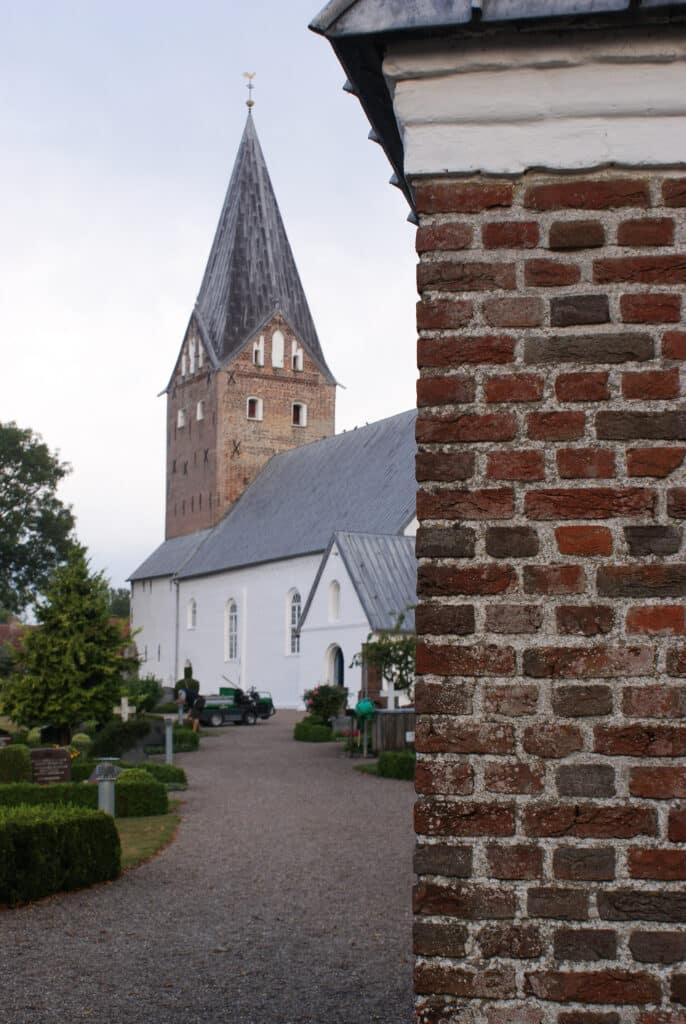
Møgeltønder Church is located between Sønderbyen and Slotsgaden, and from here four paths go in between the old houses and up to the church. The church is located at the highest point in the city, and from the church there is a fine view of the city and Tøndermarsken. The church was dedicated to St. Nicolai, the patron saint of sailors.
Church buildings
Møgeltønder church was built in the 13th century, but in the same place there used to be a wooden church and a stone church in the 1000s. From the stone church there is a granite stone with a Romanesque frieze, which now sits in the wall of the church tower.
The first stage of the church was the eastern part of the nave and a now vanished chancel. Both were built in monk stone and in Romanesque style with round arched windows and doors as well as round arch friezes adopted. In the latter part of the 13th century, the nave was extended to the west, and a new choir was built, both in late Romanesque style with altered round arch friezes.
Around 1500, the church tower was built in the late Gothic style. The church tower functioned both as a bell tower and as a beacon for the seafarers out in the watery marsh. The tower spire is very characteristic with its very high octagonal spire with small gables in every corner of the world. The church tower is of the so-called "Tørninglen type" and is similar to most church towers in the old Tørninglen Provsti. The church tower has a rather changeable history. In 1628, the tower collapsed in a Christmas storm, but was rebuilt in 1630. In 1599, the original lead roof was sold and replaced by wood shavings, as at Tønder church. In 1882 the tower got a slate roof and during the restorations in the 1970s again a lead roof.
The church bells are from resp. 1333 and 1642. The first has a cast mark and the second has the inscription Baltzer Melchior. During the First World War 1914-18, the last bell was threatened with remelting, but Count Otto Didrik Schack quickly replaced the bell with a less valuable bell from Emmerlev church, and then the Germans remelted it instead. The movement is from 1663 and has worked since, but the dials were taken down in the period 1948-77 for safety reasons.


 English (UK)